Japan's Floating Hotels: How to Save Money Traveling with Overnight Ferries
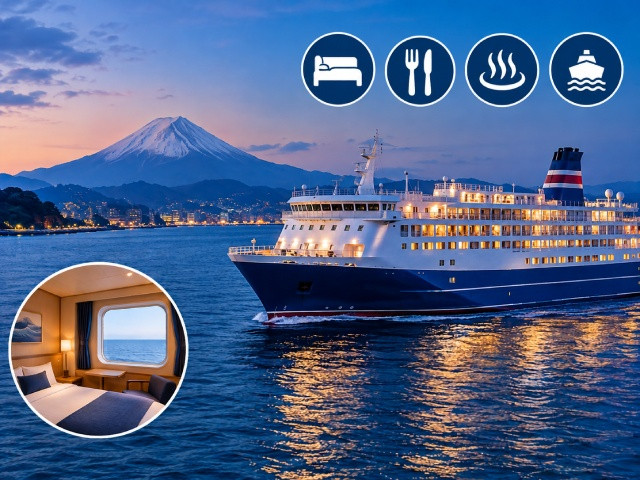
If you are looking for ways to cut travel costs in Japan without sacrificing comfort, look at your nights instead of your days. Long-distance overnight ferries combine three expenses into a single ticket: transport between regions, a hotel bed, and a classic Japanese experience — complete with ocean-view public baths (onsen). By sleeping and relaxing while you travel, you save money, skip a hotel bill, and turn lost transit time into a memorable part of your trip.
The Big Idea: A Hotel That Moves
The appeal of floating hotels in Japan is simple arithmetic. A normal travel day between Kansai and Kyushu has two costs: the ticket and the hotel at the other end. An overnight ferry folds them into one. You board around 18:00 to 20:00, have dinner as the ship passes under the great bridges of the Seto Inland Sea, and wake up at 06:00 to 08:30 in a different region.
For two people sharing a private cabin, the difference on the best-value route works out to roughly ¥10,000 to ¥30,000 ($65 to $190) compared with a Shinkansen plus a four-star hotel. That is an illustrative range, and the full comparison for each route is below. On some routes and in some cabin classes, the ferry costs the same or more. The value then lies in time and experience, not just money.
What Is Inside a Floating Hotel
The newest ships feel more like a resort than transport. Sunflower's Osaka to Beppu ship describes itself as a moving hotel, with panoramic public baths, restaurants and spacious decks. Hankyu Ferry's ships have an open-air bath on the top deck, where you can soak while watching the islands pass at night.
Comfort, though, depends heavily on the ship and the cabin you book. The main types you will see:
- Standard (shared) rooms. Japanese-style tatami areas or curtained bunks shared with other passengers. The cheapest option, with little privacy.
- Private or single rooms. Small lockable rooms, often without a window or private toilet. On Sunflower's newest ships, some "private" rooms are semi-private: they lock from the inside only and share a compartment with other rooms.
- Deluxe rooms. Private cabins for two or more, usually with a window, TV, and, on newer ships, a shower and toilet. This is the class used for the comparisons in this article.
- Suites. Larger rooms with a bathtub, sometimes a private balcony. Hankyu's top Royal class includes its own deck.
Most ships also have a buffet restaurant (paid separately), vending machines with hot meals and drinks, a shop, and on some ships a kids' play area. Check your specific ship's facilities before booking, since older vessels offer less.
How Overnight Travel in Japan Saves Money and Daytime
The case for overnight travel in Japan rests on five things, and price is only one.
You skip a hotel night. The cabin replaces the room you would otherwise book at your destination or departure city.
You keep your daytime. A Shinkansen from Osaka to Hakata takes about 2 hours 17 minutes, which sounds quick, but with check-out, station transfers, and check-in, it often eats half a day. With a ferry, you spend the full day in Osaka or Kobe, board in the evening, and start sightseeing in Kyushu after breakfast.
You arrive rested, if you sleep well. The Seto Inland Sea is sheltered, and most passengers report little rocking on these routes. Light sleepers should still book a private cabin rather than a shared room.
You get a mini-cruise. Sunset on deck, a soak in a bath with a sea view, and a slow pass beneath the Akashi Kaikyo Bridge are included.
You see Japan from the water. Islands, fishing villages, and coastal cities pass in a way no train window shows.
The trade-off is flexibility. Most routes have one or two sailings a day, so a missed ferry means a lost night. Arrival is early, often before hotels allow check-in and before many sights open.
Top 3 Overnight Ferries in Japan: Routes and Real Costs
The three routes below all run overnight for roughly 12 to 14 hours. Each comparison is for two adults, one night, in a private cabin, against two realistic alternatives. The hotel figure assumes an illustrative ¥25,000 to ¥35,000 ($160 to $225) per night for a four-star room for two in Osaka or Kobe; check current rates for your dates.
1. Kobe or Osaka to Kitakyushu (for Fukuoka): Hankyu Ferry
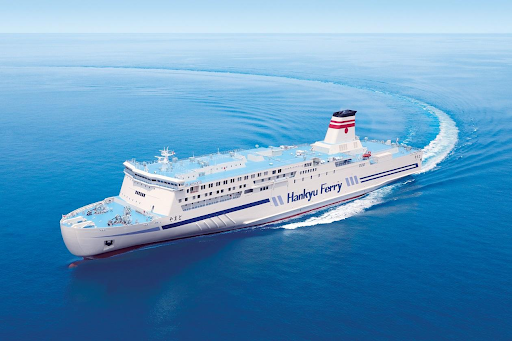
Hankyu Ferry operates daily 12.5-hour overnight sailings connecting the Kansai region (Osaka/Kobe area) with Shin-Moji port on Kyushu island.
Kobe (Rokko Island) Route:
Sunday – Thursday: Departs Kobe at 18:30 (arrives at Shin-Moji at 07:00). Returning from Shin-Moji at 18:40 (arrives in Kobe at 07:10).
Friday & Saturday: Departs at 20:00 and arrives at 08:30 in both directions.
Izumiotsu (Osaka South) Route:
Daily: Departs in both directions at 17:30, arriving at 06:00 the next morning (connecting Osaka directly with Kyushu).
One point that many guides skip: there is no overnight ferry from the Kansai region (Osaka/Kobe) straight into Fukuoka city (Hakata). The ferries arrive at Shin-Moji port in Kitakyushu instead. From Shin-Moji, a connecting bus takes you to Kokura Station, where you can catch a short 15-minute Shinkansen ride to Hakata (central Fukuoka).
*All yen prices in this article come from operators' published fare tables where stated. Dollar figures are approximate, based on ¥156 to $1 in September 2026. Comparisons with trains, flights and hotels are illustrative estimates, not quotes.
| For 2 adults, 1 night | Estimated total |
|---|---|
| Hankyu Ferry, Deluxe Western Room (Sept 2026 fares) | ¥31,460 to ¥45,540 ($202 to $292) |
| Shinkansen Shin-Osaka to Hakata (reserved, about ¥15,740 each) + 4-star hotel | ¥56,480 to ¥66,480 ($362 to $426) |
| Flight Osaka to Fukuoka (about ¥8,000 to ¥20,000 each) + 4-star hotel | ¥41,000 to ¥75,000 ($263 to $481) |
The ferry figure is Hankyu's published per-adult fare of ¥15,730 to ¥22,770 for a Deluxe Western Room, depending on season, doubled. This is the clearest saving of the three routes.
2. Osaka to Beppu: Ferry Sunflower
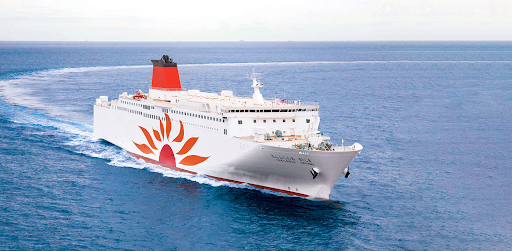
Ferry Sunflower runs the newest ships on this list, introduced in 2023, offering a 12-hour overnight journey connecting Osaka and Beppu.
From Osaka to Beppu:
Sunday – Thursday: Departs at 19:05, arriving in Beppu at 06:55.
Friday & Saturday: Departs at 20:05, arriving in Beppu at 07:55.
From Beppu to Osaka:
Sunday – Thursday: Departs at 18:45, arriving in Osaka at 06:35.
Friday & Saturday: Departs at 19:20, arriving in Osaka at 07:25.
Terminal Transfer: Buses from the Beppu terminal to Beppu Station are conveniently timed to meet arriving ferries.
| For 2 adults, 1 night | Estimated total |
|---|---|
| Sunflower, Deluxe cabin (estimate from published fare bands) | ¥48,000 to ¥76,000 ($308 to $487) |
| Shinkansen to Kokura + Sonic express to Beppu (about ¥17,500 each) + 4-star hotel | ¥60,000 to ¥70,000 ($385 to $449) |
| Flight Osaka to Oita (about ¥10,000 to ¥25,000 each) + airport bus + 4-star hotel | ¥45,000 to ¥85,000 ($288 to $545) |
Here a deluxe cabin in peak season can cost more than the train and hotel. Sunflower's cheaper private and semi-private rooms change that: one couple paid ¥30,580 for two in a semi-private room. Choose this route for the ship itself and for waking up in a hot-spring town, and pick the cabin class that fits your budget.
3. Kobe to Miyazaki: Miyazaki Car Ferry
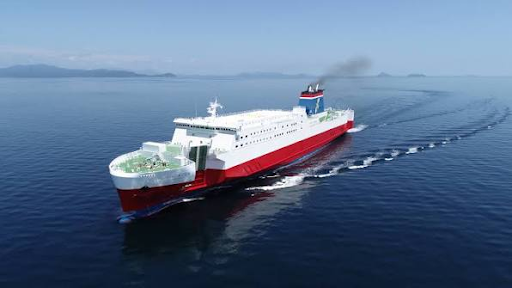
Miyazaki Car Ferry operates two ships launched in 2022, offering an overnight journey between Kobe and Miyazaki (taking roughly 12.5 to 13.5 hours).
From Kobe to Miyazaki:
Monday – Saturday: Departs Kobe at 19:10, arriving in Miyazaki at 08:40.
Sunday: Departs Kobe at 18:00, arriving in Miyazaki at 08:40.
From Miyazaki to Kobe:
Daily: Departs Miyazaki at 19:10, arriving in Kobe at 07:30 the following morning.
Route Note: Unlike the Inland Sea routes, this ferry runs along the open Pacific coast. The ships are equipped with anti-roll stabilizers for a smoother ride, though some motion is still possible in rough weather.
| For 2 adults, 1 night | Estimated total |
|---|---|
| Miyazaki Car Ferry, private first-class room (aggregator range ¥25,000 to ¥34,000 each) | ¥50,000 to ¥68,000 ($321 to $436) |
| Train via Kagoshima (about 8 hours, ¥21,000 to ¥30,000 each) + 4-star hotel | ¥67,000 to ¥95,000 ($429 to $609) |
| Flight Osaka Itami to Miyazaki (¥9,000 to ¥44,000 each) + 4-star hotel | ¥43,000 to ¥123,000 ($276 to $788) |
Miyazaki has no Shinkansen connection, so the train alternative takes most of a day. That makes the ferry especially strong here for time, even when a cheap flight beats it on price.
Ferry fares change by season and are sometimes adjusted for fuel costs. Always confirm on the operator's fare calendar before booking.
Seamless Luggage: Travelling Without Suitcases (Takkyubin)
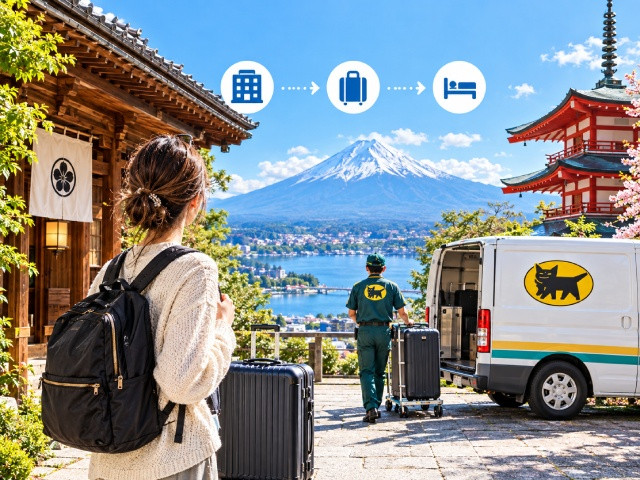
The awkward part of a ferry day is the suitcase. You check out of your hotel around 10:00, the ship leaves at 19:00, and your next hotel will not let you in until mid-afternoon the following day. Japan's door-to-door luggage delivery service, Takkyubin, solves all three gaps.
- Morning of departure. Hand your suitcase to the front desk of hotel A, or drop it at a nearby 7-Eleven or FamilyMart, for delivery by Yamato Transport (TA-Q-BIN).
- Address it to hotel B. Send it to your next hotel in Kyushu for delivery the following day. Allow at least one full day for this distance, and more around holidays.
- Travel light. Spend the day exploring the port city with a small bag, sleep on the ferry, and head straight out sightseeing when you dock. Your suitcase will be waiting in the lobby of hotel B.
For costs, time limits, and what you cannot ship, see our full guide to takkyubin luggage delivery in Japan.
What to Bring on Board
Pack a small bag for one night: documents, electronics, medication, and anything you need before your suitcase arrives. A few items specific to Japanese ferries are easy to overlook.
No plug adapter is needed for Japanese devices, but you may need one for yours. Cabins use Japan's standard Type A sockets at 100V, and many beds have USB ports. Visitors from Europe, the UK, or Australia need an adapter.
¥100 and ¥500 coins. Coin lockers, massage chairs, laundry and vending machines on board often take coins only. Change machines exist but are not always near the machine you need.
A small bag for the bath. Towels are provided in private cabins, but you will want something to carry them and a change of clothes to the public bath. Japanese baths are used without swimwear, and some limit visible tattoos, so check the ship's rules.
Easy slip-on shoes. You will walk between cabin, bath, restaurant, and deck many times. Some cabins provide slippers; bring your own if you prefer.
A refillable bottle. Several ships have free water and tea dispensers.
Breakfast timing. Arrivals are early, and on some ships the breakfast buffet runs for less than an hour before docking.
Taking a Rental Car on the Ferry (Road Trip)
All three routes carry cars, making the ferry a natural link in a Kansai-to-Kyushu road trip. You skip around 600 to 800 km of expressway driving and tolls, and wake up with your car ready for Kyushu's rural roads.
What it costs. On Hankyu's Kobe route, a car under 5 m costs ¥26,400 to ¥34,320 ($169 to $220) one way, depending on season. The driver's basic shared-room fare is included; upgrading to a private cabin means paying the difference. Other operators price cars by length in a similar way.
When to arrive. Hankyu asks passengers to arrive at least 60 minutes before departure, or 90 minutes during Golden Week, summer holidays, and New Year. Car passengers usually check in earlier than foot passengers, so confirm your operator's cut-off.
Loading. Crew directs each car onto the vehicle deck with hand signals. Follow them exactly, switch off the engine, apply the handbrake, and leave the car in gear or park.
Take everything you need first. Car decks are closed while the ship is sailing, and you cannot go back to your car until arrival. Take your overnight bag, medication, chargers, and valuables with you when you park.
Check your rental agreement. Not every rental company allows its cars on ferries, and returning the car in another region usually adds a one-way drop-off fee. Ask before you book.
Internet on the Ferry and on Land
Ship Wi-Fi is limited.
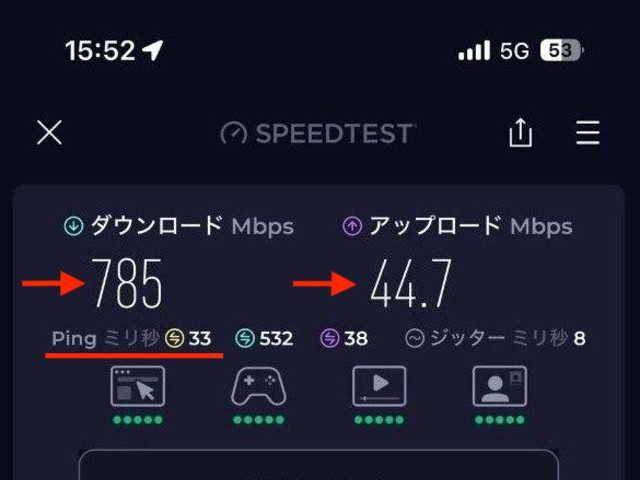
Most long-distance ferries offer free onboard Wi-Fi in public lounges, but it relies on limited satellite or terrestrial links. Speeds are slow, connections drop frequently, and coverage rarely extends to private cabins. On operators like Miyazaki Car Ferry, sessions are strictly capped (e.g., two 20-minute slots per day). Treat ship Wi-Fi as a backup tool for light messaging rather than video calls or heavy downloads.
Mobile signal depends on the route.
Out in the open sea, standard cellular signals disappear completely. However, routes navigating through the Seto Inland Sea (such as those to Kitakyushu and Beppu) stay close to the coast for much of the journey, allowing land-based towers to reach the ship for long stretches. In contrast, offshore routes like Kobe to Miyazaki travel further out, resulting in frequent signal gaps.
Reliable data makes getting around much easier.
Having reliable mobile internet makes all the difference when managing ferry travel logistics: finding the correct terminal in complex ports like Osaka, checking shuttle schedules, and pulling up digital QR boarding passes. Moreover, when your ship sails close to the coastline, a local cellular connection lets your phone pick up signal directly from onshore towers along the route.
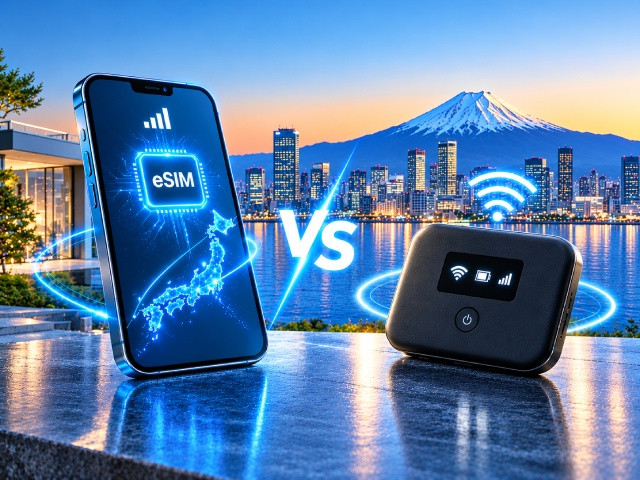
An eSIM is an ideal solution for your trip.
To ensure you stay connected both on land and along coastal routes, setting up an eSIM before departure is the simplest way to secure reliable mobile data. Install your eSIM right at home, and as soon as you land, it activates and connects you directly to Japan's top-tier KDDI network for stable, high-speed 5G data. By sorting out your connectivity in advance with Awinst Connect, you can easily pick a plan that fits any budget, data volume, and travel style, ensuring a seamless experience from the very first second of your trip.
Install your eSIM at home, activate in Japan — View plans (Use code PROMO10)
Booking Tips
Book directly on the operator's site where possible. Resellers such as WILLER TRAVEL and KKday also sell English-language tickets, usually from two months out to a few days before departure.
Two booking quirks catch foreign visitors. Some Japanese booking forms ask for names in hiragana rather than Latin letters. Sunflower's online reservations also work in two steps: you reserve first, then receive a separate email to pay, and unpaid bookings are cancelled after three days.
Savings on these routes come mainly from choosing off-season dates (each operator prices days in bands from A, lowest, to D, peak), booking online, and return discounts.
At the terminal, bring your reservation number and passport. On Sunflower, your QR code opens your cabin, and doors lock automatically, so keep the key on you.
FAQ
How Many Days in Advance Should You Book a Ferry Ticket to Get the Lowest Price?
Booking usually opens about two months ahead. Price depends mainly on the date's season band, not how early you book. Choose an off-season date, book online for discounts, and reserve early for deluxe cabins, which sell out first.
What Is the Most Convenient Way to Get to the Port from the City Center?
Most terminals are outside city centers. Hankyu runs shuttle buses from nearby stations, and bus seats are limited, so reserve them. Sunflower's Osaka terminal is about 30 minutes from Umeda by train. Kobe's Miyazaki ferry terminal has buses from Sannomiya.
Do I Have to Pay Any Port Fees in Addition to the Ticket Price?
For passengers, generally no. Hankyu's published fares already include the fuel surcharge and 10% consumption tax. Meals, bath towels on some ships, and vehicle fees are extra. Fuel-related fares can change, so check at booking.
Are Pets Allowed on Board the Ferry?
Yes, with conditions. Hankyu has pet rooms with cages and pet-friendly deluxe cabins on its Kobe route ships. Sunflower's Osaka to Beppu ships have Deluxe with Pet rooms. Pet fees apply, and pets usually cannot enter public areas.
If My Plans Change, Can I Cancel My Ticket and Get a Refund?
Yes, minus a fee. On Hankyu, cancelling seven or more days ahead costs ¥200 (about $1.5). For private cabins, the fee rises to 10% from six to two days before, 30% on the final day, and 100% after departure.
Conclusion: Run Through This Checklist Before You Book
Overnight ferries in Japan aren't always the cheapest way to travel, but on the right route and in the right cabin, they save a hotel night and a half-day of transit at the same time. Before you book, run through this list:
- Ferry fare for your exact date and cabin class, checked on the operator's calendar
- Shinkansen or flight fare for the same trip, plus transfers to the airport or station
- Hotel price at your departure or arrival city for the night you would skip
- Meals on board, which are usually extra
- How you will reach the terminal, and whether the shuttle bus needs a reservation
- Where your suitcase will go (Takkyubin, or carry it on board)
- Whether you sleep well in a moving room, and which cabin gives you enough privacy
- What you will do between an early-morning arrival and hotel check-in
If the ferry wins on at least two of cost, time and experience, it is probably worth booking.