Best eSIM for Japan for Digital Nomads: 2026 Guide
JAPAN eSIM FOR DIGITAL NOMADS: HOW A BUSINESS TRIP DIFFERS FROM ORDINARY TOURISM
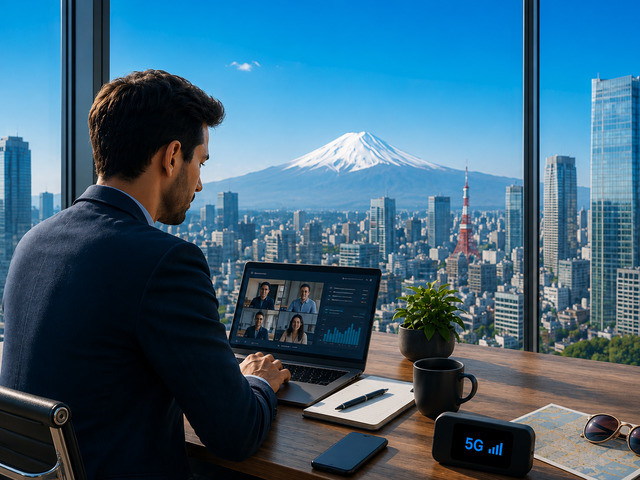
There are two types of travelers to Japan. The first is the tourist: Google Maps, Instagram, texting family. The second is the digital nomad: morning stand-up with the team, screen sharing with a client, laptop hotspot at a cafe in Shibuya. The difference between the two is 2GB per day versus 10GB per day.
This is where most “unlimited” eSIM for digital nomads plans fall short. They’re designed for tourists. A 3–5 GB-per-day limit seems generous if you’re just scrolling between landmarks. But if your workday includes several hours of video calls, that might not be enough to get you through lunch.
Mobile traffic peaks in Japanese cities during business hours, from 9 am to 6pm, when millions of people are online simultaneously. This is when connection quality is most critical - and it's when the weaknesses of "unlimited" plans are most apparent.
The main pitfall for digital nomads: the daily 3 GB limit is less than two hours of HD video calling. If your workday includes 3–4 hours of Zoom, plus a laptop hotspot, the limit may run out long before the evening. After that, the speed drops so much that a normal call becomes impossible.
How much data does a digital nomad need per working day?
| Activity | GB/hour | 4-hour usage |
|---|---|---|
| Zoom / Google Meet HD | ~1.5 GB | ~6.0 GB |
| Slack / Messengers | ~0.8 GB | ~3.2 GB |
| Laptop Hotspot (Email + Browser) | ~0.5 GB | ~2.0 GB |
| Cloud Sync in the Background (Dropbox/Drive) | ~0.3 GB | ~1.2 GB |
| Total: Typical Workday | ~8–12 GB | |
The conclusion is simple: for a full working day, a digital nomad needs a plan with no daily limits and no speed throttling. Any traffic limitation automatically becomes a risk to productivity.
WHAT IS “FUP” AND WHY IS IT A PROBLEM FOR DIGITAL NOMADS
"FUP" - Fair Usage Policy - is a term that providers use to describe their "fair usage" policy for unlimited plans. In practice, this means: you buy an "unlimited" plan, but after a certain daily data volume (usually 3-5 GB), the speed drops sharply - sometimes to the point where it is impossible to open even a simple page normally.
For a tourist, this is often not a big deal: Google Maps will still load, and messages will be sent to the messenger. But for a digital nomad, the consequences are different: a video call that was just going fine suddenly starts to freeze, the screen during screen sharing takes minutes to load, and a file synced to the cloud freezes halfway through.
The worst thing is that it happens unpredictably. If you spent a long day on video conferences yesterday and the limit hasn't been restored yet today (it's often updated once a day at a certain time), your important morning call may be interrupted before you even realize it.
How to check for hidden FUP before buying: Look for the phrase "fair usage policy", "daily cap", or specific GB/day figures in the plan terms. If the provider doesn't specify an exact figure, it's worth looking for this information on the provider's Terms page or asking support directly.
RECOMMENDED PLAN: NO DAILY LIMITS
If you plan to work actively while traveling in Japan, the most important criterion for choosing an eSIM is not the price or brand, but the presence of true unlimited data: no daily volume limit, no forced speed reduction in the middle of the day.
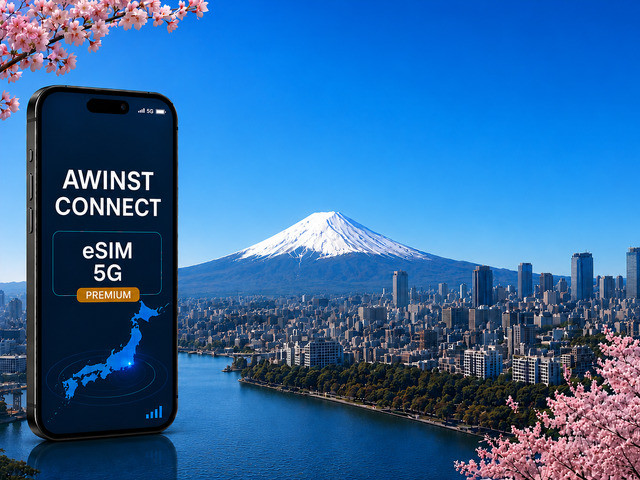
Awinst Connect is an eSIM provider for Japan that has built its offering around this very principle. No daily limit, no hidden FUP - the speed remains the same on the first and last day of the plan.
Here are some of the benefits of Awinst Connect:
- No daily traffic limit
- Laptop hotspot
- Connection via KDDI au network - stable 5G in cities
- 180 days to activate - buy in advance, activate when you land
- Installation in minutes via QR code
- Stable quality during screen sharing and video calls
- Activation online, without registering a passport.
This is technically possible because Awinst Connect is not designed around the average tourist using 1 GB of data per day. Instead, the plan is designed for real workloads, including video calls and working across multiple devices via a hotspot.
WHICH NETWORK TO CHOOSE TO WORK IN JAPAN
Japan has three major mobile networks - Docomo, KDDI au, and SoftBank. For a digital nomad who works mainly in large cities (Tokyo, Osaka, Kyoto, Fukuoka), the key indicator is the stability of the 5G signal, especially in business districts and coworking-dense areas.
KDDI au - recommended for digital nomads
KDDI au provides some of the fastest 5G speeds in the central business districts of Japanese cities, where most of the coworking spaces, cafes, and hotels where you are most likely to work are concentrated. For video calls and screen sharing, signal stability at such times is more important than theoretical coverage in mountainous terrain, which is rarely needed during a work trip.
Awinst Connect works on this network as part of its unlimited tariff - that is, you get both a stable signal for work and no daily speed limits.
For most digital nomads, this means that you don't need to delve deeply into the differences between carriers - just know that the plan is connected to a network with good coverage in the cities where you'll spend most of your working time.
COWORKING IN JAPAN: WHY YOUR OWN eSIM IS MORE IMPORTANT THAN WIFI
Counterintuitive but important tip: even in the best coworking spaces, you shouldn't rely on their WiFi as your primary connection for critical work. During peak hours - when dozens of people are on video calls at the same time - the shared bandwidth is shared between everyone. One "heavy" neighbor downloading a large file can affect the quality of your call.
Another hidden risk: the WiFi network may require you to re-authenticate through the portal just when you're about to make a call. With your own eSIM, there's simply no such problem - the connection is completely under your control.
Simple rule: your own eSIM is the primary connection for all video calls and important work. Coworking WiFi is just a backup for large downloads and non-critical tasks.
It is worth mentioning separately: many providers' FUP limits are triggered precisely at times of peak load, when you are simultaneously on a video call and sharing a hotspot with a laptop for a presentation. That is why a plan without daily limits gives real peace of mind, and not just theoretical "unlimited" on paper.
"The biggest mistake digital nomads in Japan make is planning an important client call right after landing or while traveling between cities. Check your connection in advance, and have a plan with no hidden speed limits - it saves more nerves than any other preparation." - practical advice for digital nomads in Japan.
DUAL SIM STRATEGY: WHY KEEP YOUR HOME SIM ACTIVE
This is a simple but often-overlooked tip: keep your home-country SIM card active throughout your trip, even if your primary internet access is via a Japanese eSIM.
Japanese eSIM - the main connection for all work:
- All video calls and Zoom
- Laptop hotspot
- Navigation and browsing
- Cloud sync and download
Home SIM - leave active, SMS only, no data:
- SMS from the bank during transactions
- Two-factor authentication of services
- Confirmation from airlines
- Messages from government services
How to set up: on iPhone - Settings → Cellular → select Japanese eSIM as the main one for data. On Android - Settings → Connections → SIM Manager → select Japanese eSIM for mobile data. On your home SIM - turn off "Data roaming" without turning off the SIM completely.
Critically important: only disable data transfer to your home SIM - not the SIM card itself. If you disable it completely, you will not receive SMS for two-factor authentication of corporate services. And without it, you can lose access to work accounts at the most inopportune moment.
FAQ: FREQUENTLY ASKED QUESTIONS
How many GB do I need for a full day of work with video calls?
Aim for 6–10 GB per day if you have 3–4 hours of video calls and use a laptop hotspot. Plans with a daily limit of 3 GB will cover up to 2 hours of Zoom. For full-time work, you need a plan without daily speed limits.
Does corporate VPN work with Japanese eSIMs?
Usually yes, but there is a caveat: some providers limit VPN traffic or give it a lower priority. We recommend that you clarify this information directly with the provider before departure.
Which is better for work - eSIM or pocket WiFi?
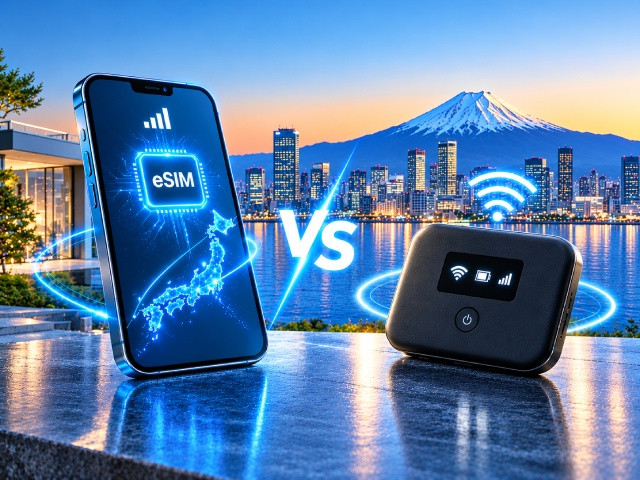
eSIM is more convenient for most digital nomads: you don't need to carry a separate device, charge it, or worry about losing it. Pocket WiFi makes sense if your smartphone or tablet doesn't support eSIM technology or is locked by your carrier - then such a device may come in handy.
Can I get a Japanese phone number with an eSIM?
Some providers offer this as a separate option, with a mandatory requirement to verify identity documents. For most digital nomads, a Japanese number is not critical - most work and personal communications are done online (Zoom, Slack, messengers), and not through traditional calls or SMS.
How do I maintain access to my bank and two-factor authentication while traveling?
Leave your home country SIM in your phone, but turn off data on it (not the SIM itself). This way, you'll continue to receive SMS messages for 2FA and bank confirmations without incurring expensive data roaming charges.
Does the daily limit (FUP) affect the quality of video calls?
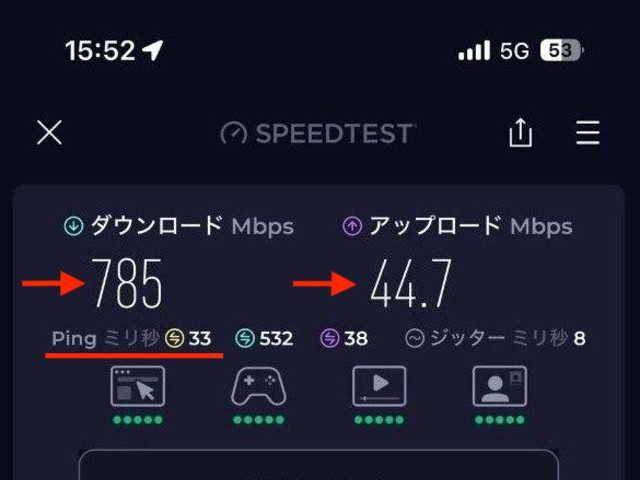
Yes, significantly. After reaching the daily limit, the speed usually drops to 1–2 Mbps. The minimum for a stable HD video call is 3–5 Mbps. That is, after the FUP, the call either degrades to audio or drops altogether.
Can I use one eSIM on my phone and laptop at the same time?
Directly - no, eSIM is installed only in the phone. But you can distribute the Internet from the phone to the laptop via a hotspot. It is important to check whether the plan does not have a separate, additional limit specifically for hotspot traffic - some providers count it differently than the main phone traffic.
CONCLUSION
If you're traveling in Japan and still working, choosing an eSIM stops being a matter of convenience and becomes a matter of productivity. The hidden daily limit that cuts off a video call in the middle of an important presentation costs much more than the price difference between plans.
The main things to look for are: no daily FUP limits, hotspot support, and a stable 5G connection in the cities where you work. eSIM provider Awinst Connect combines all three criteria in one plan - no hidden conditions and no surprises in the middle of the workweek.
Choose your Japan eSIM plan and enjoy reliable mobile internet from the moment you arrive.